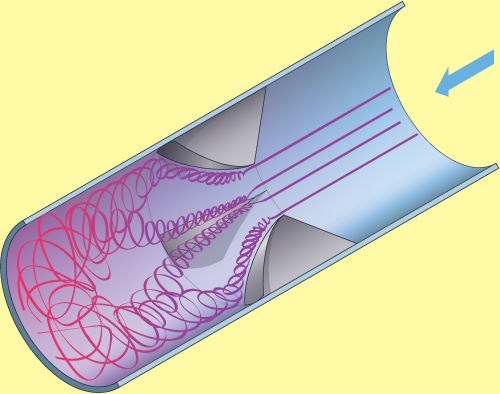
The 3050 series low-pressure mixers are designed for applications requiring minimal pressure loss combined with high mixing performance. These mixers offer excellent mixing performance and are available in ten different pipe diameters.
| Past | Value of K | Coronavirus |
|---|---|---|
| one | 0.58 | 0.057 |
| two | 1.13 | 0.026 |
| three | 1.64 | 0.014 |
He represents
In many industries, the homogeneous mixing of liquids is crucial for the quality of the final product, the reduction of energy consumption, and the increase of production efficiency. Stationary mixers are among the most widely used devices in this field. Among the various types of stationary mixers, low-pressure mixers stand out due to their optimized design and lower cost .
This stationary mixer requires no moving parts and consumes no additional energy, allowing the mixing process to be carried out with minimal voltage drop. This article provides an overview of the concepts, characteristics, advantages, applications, and design methods of low-voltage stationary mixers.
What is a food processor?
A static mixer is a device installed inside a pipe that uses internal, stationary elements to uniformly mix liquids . Unlike dynamic mixers, static mixers do not contain motors, impellers, or rotating parts; instead, they utilize the energy of the liquid flow to achieve mixing.
Mixing in a stationary mixer is carried out using the following mechanism:
-
deviation
-
Change the direction and create a controlled disturbance.
-
Increase the contact area.
The concept of pressure losses (head losses) in stationary mixers
Pressure loss refers to the decrease in fluid pressure along its path, typically caused by friction, deformation, and internal obstructions . In industrial plants, significant pressure drops can lead to the following problems:
-
Increased energy consumption of the water pump
-
Reduce system traffic
-
Increase in operating costs
Therefore, a stable engine design that ensures minimal pressure loss is of utmost importance.
What is a low-pressure static mixer?
A low-temperature static mixer is a specialized static mixer with custom-designed internal components that ensure highly efficient mixing of liquids with minimal pressure loss . The main objective of this type of mixer is to achieve an optimal balance between mixing quality and reduced hydraulic resistance.
These mixers typically have the following features:
-
Aerodynamic design of the components
-
Avoid sharp corners and sudden obstacles.
-
Use the optimal amount of the mixed elements.
Operating principle of a low-loss static mixer
This stationary mixer operates with intelligent flow control. As the liquid flows through the pipe:
-
Constant elements divide the process into multiple levels.
-
The path of the liquid changes slowly.
-
All classes will be reunited.
-
This process should be repeated several times until the mixture is thoroughly blended.
None of these steps will cause serious problems or a significant drop in blood pressure.
Advantages of stand mixers with low voltage drop.
1. Reduction of energy consumption
By reducing the pressure loss, the power required to operate the pump is reduced , thus lowering energy consumption .
2. Improvement of system efficiency
A homogeneous mixture without flow restrictions can improve the overall performance of the system.
3. Extremely low maintenance costs.
Since the device has no moving parts, its costs are practically zero.
4. Long lifespan
The simple and reliable design contributes to extending the device’s lifespan.
5. Easy installation.
These taps are easy to install in the pipework and do not require any additional space.
The most important differences between low-pressure fittings and normal fittings
| Special feature | Traditional stand mixer | Stationary mixer with low pressure loss |
|---|---|---|
| Low blood pressure | higher | strange |
| Energy consumption | additionally | fewer |
| Design elements | Complex and integrated | Simplified and improved |
| Inquiry | Mix in large quantities | Mixed with energy sensitivity |
Application of stationary mixers with low voltage drop
1. Water supply and wastewater disposal
-
Chemical injection
-
pH value adjustment
-
mixed coagulants
2. Oil, gas and petrochemical industry
-
Mixed additives
-
Homogenization of process fluids
-
Injection of corrosion protection material
3. Food industry
-
mixed drink
-
uniform taste
-
Working with sensitive liquids
4. Pharmaceutical industry
-
mixed medical solution
-
Maintain the quality of materials that are easy to cut.
5. Chemical Industry
-
Reduction of matter
-
Reagent mixture
Materials used in construction
Stationary electric motors with low pressure loss are manufactured from various materials depending on the application:
-
Stainless steel (304 and 316)
-
carbon steel
-
Polypropylene (PP)
-
Both PVC and PVDF are suitable for use in aggressive environments.
Important criteria when choosing a food processor: low pressure.
When choosing the right mixer, you should consider the following points:
-
Flow rate and viscosity
-
Operating pressure and temperature
-
The required amount of mixture
-
Maximum voltage drop in the system
-
Connection types ( flange , welding, thread)
The role of design engineering in reducing stress drop
The precise design of components using CFD (Computational Fluid Dynamics ) methods is crucial for minimizing pressure loss. Analyzing flow paths and turbulence points enables the development of optimal structures that maximize mixing and minimize resistance.
Why is a stationary low-pressure mixer a cost-effective option?
At first glance, the purchase costs of these devices may seem somewhat high, but in the long term:
-
Reduction of energy consumption
-
Reduced maintenance costs
-
Improving process stability
This makes this type of stand mixer an absolutely cost-effective purchase .
In conclusion
Stationary low-pressure mixers are a modern, efficient, and cost-effective solution for mixing liquids and are ideally suited for a wide range of industries. Thanks to their sophisticated design, stable operation, and low energy consumption, these devices contribute significantly to improving industrial processes.
If you want to increase efficiency, reduce operating costs and improve the mixing quality in your system, using a stationary mixer with low pressure loss may be one of the best options for you.