Oil platforms are complex, high-pressure environments with extremely limited space. On these massive offshore platforms, the selection and design of all equipment must be geared towards minimizing maintenance , maximizing efficiency , and ensuring optimal stability. Stationary mixers have played a key role in oil exploration and production in recent years . These devices, with no moving parts, feature a simple design and advanced functionality, enabling easy mixing, homogenization, chemical injection, and fluid enrichment on oil platforms.
This article discusses the applications, benefits, types and strategic role of stationary mixers on offshore oil platforms and analyzes the reasons why these devices have become one of the best options for the offshore oil and gas industry.
What is a food processor?
A stationary mixer is a tubular or tank-like device consisting of a series of stationary elements through which a liquid is continuously circulated, mixed, pulverized, and stirred . Since this system contains no motors or moving parts, the energy required for mixing is provided solely by the energy of the liquid itself .
This characteristic makes stationary mixers the ideal choice for maintaining plants in high-risk offshore environments where this is difficult.

Why are stationary mixers suitable for oil platforms?
Oil drilling platforms typically face the following limitations:
-
Limited work area
-
High maintenance and repair costs
-
The staff are having difficulty accessing the equipment.
-
Adverse environmental conditions such as humidity, corrosion, and vibrations.
-
The need for reliable and durable equipment
These stationary mixers are ideally suited to these requirements and offer advantages such as cost-efficiency, reliability, and maintenance-free operation. Their key advantages in marine applications include:
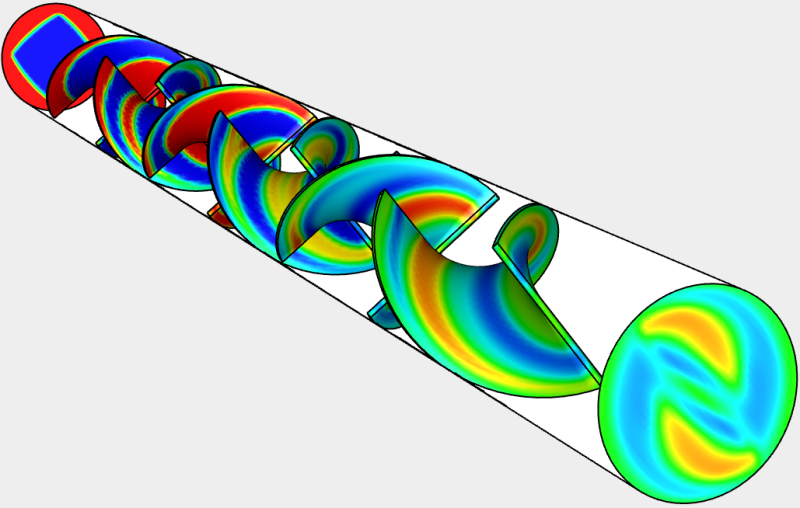
1. It contains no moving parts and requires no regular maintenance.
On oil drilling platforms, every rotating or continuously operated system poses operational risks. Stationary mixers, on the other hand, require virtually no maintenance.
2. Zero energy consumption
The mixing process requires neither electricity nor a motor; only electrical current is needed.
3. Corrosion resistance
They can be made from materials that are resistant to marine corrosion , such as:
-
Two-story apartment
-
Super maisonette apartment
-
Hastelloy
-
Inconel
-
316L stainless steel
4. The installation site is very small.
Space is limited on oil platforms; stationary mixers can only be installed on a single pipe.
5. Extremely high mixing performance
This applies even under conditions of high flow rates and multi-stage flow.
Use of stationary mixers on oil drilling platforms
Stationary mixers are widely used in various phases of offshore exploration and production. Below, we will examine their most important applications in more detail.
1. A mixture of chemicals that is introduced into infusion lines.
Various chemicals are injected into the production line on an oil platform, including:
-
Corrosion inhibitors
-
Sedimentation inhibitors
-
Antiparaffin
-
Emulsifier
-
bactericide
-
To prevent the formation of hydrates, use methanol or ethylene glycol.
If these materials are not properly mixed during injection, their effectiveness can be reduced by up to 50%. Stationary mixers ensure a uniform mixture even at high flow rates, thus guaranteeing that the chemicals:
-
completely dissolved in the liquid
-
Use liquids for a faster reaction.
-
Reduction of drug use
-
Reduction of the risk of local erosion
2. Improve the water-oil separation (drying) process in the initial stage.
The fluid emerging from a borehole typically consists of the following components:
-
oil
-
gas
-
Free water
-
Emulsified water
-
solid
The homogeneity of the liquid is crucial before it enters the three-stage separator . A stationary mixer facilitates this process by breaking up the stabilized emulsion and using a demulsifier for mixing.
-
Reduction of separation time
-
Improving teamwork skills
-
The quality of the oil produced will improve.
3. Multi-stage mixing
Phase separation occurs in the extracted oil within the wellbore and the pipeline. Phase instability can lead to the following:
-
Flow measurement error
-
printing press
-
Localized erosion
-
Faults at the input of the processing unit
Stationary mixers are designed to standardize liquids and stabilize the operation of power transmission lines by evenly distributing gas, oil, and water.
4. Improvement of the measurement efficiency of frame-mounted measuring instruments.
For an accurate measurement of oil and gas flow, the flow rate must be perfectly uniform . Otherwise:
-
The measurement error has increased.
-
Oil sales data often contains errors.
-
There were problems with the contracts.
Therefore, stationary mixers are usually used in measuring systems that are upstream of the flow meter.
5. Used in gas desulfurization towers and in contract processing.
On gas platforms, for example:
-
Amino acid connectors
-
washing machine
-
Seawater desalination plant
Stationary mixers are used to increase the contact area between liquids and gases, thereby increasing the efficiency of the absorption process.
6. Mixed gas injection for increased performance
Gas is injected into oil wells to increase reservoir pressure or improve oil production. Stationary mixers are used in the gas injection lines.
-
Mixing gasoline with oil
-
Uniform gas distribution in the airflow
-
prevent pressure shock
7. Application in MEG injection systems for underwater pipelines
Ethylene glycol (MEG) or methanol are used in offshore pipelines to prevent the formation of hydrates. Stationary mixers help with this.
-
MEG is evenly distributed in the liquid.
-
Reduce your MEG intake.
-
Faster hydration control
8. Mixing when handling drilling fluids
Also used for mixing in the drilling control unit (drilling fluid system):
-
polymer
-
Barite
-
Antifoaming agent
-
Materials with improved density
A food processor is used.
Stationary mixers, suitable for oil drilling platforms
Select the appropriate mixer type depending on the type of liquid and operating pressure:
1. Built-in stationary pipe mixer
The most common model, suitable for oil and gas pipelines.
2. Stationary multi-stage mixer
It is used for mixing oil, gas and water at high flow rates.
3. Stand mixer with spiral heating element or SMX
Suitable for highly viscous materials.
4. Corrosion-resistant mixer (stationary mixer made of special alloy)
Suitable for use in marine environments and with aggressive liquids.
5. Axial or jet mixer
Inject chemicals precisely into the specified area.
Materials suitable for marine environments
Depending on the corrosion conditions, the following materials can be selected:
-
Superduplex stainless steel (2507, 2205) – resistant to chloride corrosion
-
Hastelloy C276 – suitable for highly corrosive liquids
-
Inconel 625 and 825 : High temperature and pressure resistance
-
316L – Economical and corrosion-resistant
-
Class 2 titanium alloys : lightweight and high-strength
By choosing the right materials, the lifespan of devices can be extended to 20 years or more.
Stationary mixers solve problems on oil drilling platforms.
| Attempt | The role of a stand mixer |
|---|---|
| Separation of the mobile phase | Complete homogeneity |
| Low chemical properties | Improvement of injection efficiency |
| linear deposits | Mix the ingredients thoroughly to avoid any build-up. |
| Localized erosion | Avoid hotspots |
| Reduced separator performance | Improvement of oil-water separation |
| Measurement error | Smoothing of the flow before the flow meter |
Economic advantages of using stationary mixers on oil drilling platforms
The use of this device can significantly reduce the platform’s operating costs:
-
Reduce your chemical consumption by up to 30%.
-
Reduction of production downtime
-
Extending the lifespan of power lines
-
Reducing maintenance costs
-
Improve the accuracy of your consumption measurements and generate higher revenues.
In conclusion
In the harsh, costly, and confined environments of oil platforms, equipment must be stable, simple, robust, and reliable . These qualities have made stationary mixers an indispensable component of oil and gas exploration and production.
Stationary mixers play a crucial role: from chemical injection to the homogenization of multi-stage flows , the improvement of separator performance and the increase of measurement accuracy.