The collection and disposal of waste gases, especially flare gases, has long been a serious problem in the oil, gas, and petrochemical industries. Combustion of excess flare gases not only results in energy losses but also pollutes the environment. Due to increasingly stringent regulations and growing environmental awareness, companies are implementing new technologies to reduce emissions and recycle flare gases.
A liquid gas ejector is a highly effective technology in this area . This device uses liquid fuel (usually water or process fluid) to extract flare gas and transport it to other systems. The following sections describe how ejectors work, their advantages, applications, and their importance for flare gas capture.
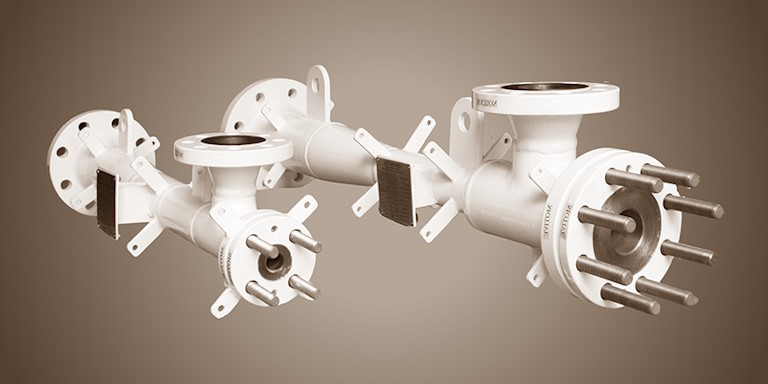
What is a liquid gas launcher?
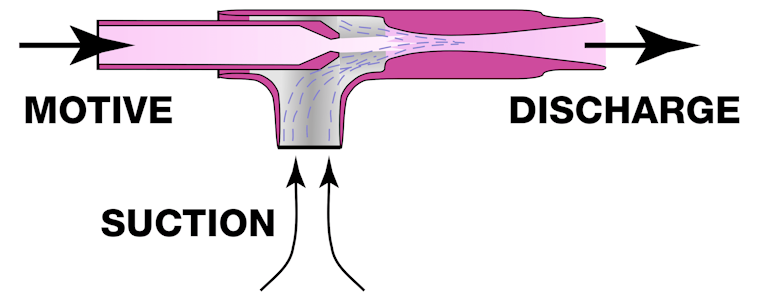
A gas-liquid ejector is a stationary device with no moving parts. Its operating principle is based on the Venturi principle and the laws of fluid dynamics. In this device, a pressurized liquid (water, process fluid, or a special solution) enters the ejector nozzle as the working medium. The increase in velocity and the drop in pressure in the nozzle throat create a vacuum . Here, the target gas (in this case, flare gas) is drawn into the ejector and mixed with the working medium. In the diffuser section, the kinetic energy is converted into pressure, which directs the gas-liquid mixture to the desired location.
Why are ejectors suitable for flue gas capture?
Flare gas typically develops under variable flow and pressure conditions. The use of compressors or rotating equipment for capture is expensive and risky. Ejectors are the ideal choice due to their simple design and high reliability. The main reasons for choosing ejectors are:
-
No moving parts : requires minimal maintenance and reduces the likelihood of failure.
-
Ensures stable operation under changing conditions – can handle changes in flue gas flow and pressure.
-
The investment and operating costs are low compared to compressor and mechanical systems.
-
Possibility of using existing process fluids such as cooling water or process fluids without additional energy requirements.
-
Durability and long service life even under corrosive conditions or in harsh industrial environments.
Use of ejectors to collect combustion products
Liquefied natural gas ejectors are widely used for flare gas management in various oil and gas projects. Their main applications include:
-
Reduction of pollutant emissions : Avoiding the direct combustion of flue gases and reducing emissions of carbon dioxide and sulphur compounds.
-
Energy recovery : Transport of flue gas to processing units such as boilers or steam generators.
-
Increased safety : Reduces overpressure in pipes and prevents dangerous gas accumulation.
-
Regulatory compliance : meeting environmental regulations and reducing fines for pollution.
Ecological and economic benefits
The use of ejectors to capture flue gases is not only a technical measure, but also has significant economic and ecological consequences:
-
Reduced air pollution : By avoiding the combustion of exhaust gases, emissions of greenhouse gases and harmful particles are reduced.
-
Avoiding waste of resources : Flare gas often contains methane, light hydrocarbons, and valuable compounds. Flare gas recovery offers an alternative energy source.
-
Reduces maintenance costs : Thanks to its simple design, the launcher does not require extensive repairs or maintenance.
-
Fast return on investment : Energy savings and the avoidance of environmental penalties can shorten the payback period.
The main components of a LPG ejector
The launcher consists of several main parts:
-
Working nozzle : Here the liquid enters under high pressure and is accelerated.
-
Suction nozzle : the point at which combustion products enter the system.
-
Mixing chamber : The area where gas and liquid are mixed.
-
Diffuser : The part that recovers kinetic energy in the form of pressure and transports the gas-liquid mixture to the outlet.
To intensify the process, Kenics uses stationary mixers.
Selecting a power steering fluid
The choice of working fluid is a crucial factor in the ejector’s performance. Many projects use cooling or process water as the working fluid. In some cases, special process fluids or solvents are also used. Criteria for selecting the fluid include availability, corrosiveness, temperature, viscosity, and compatibility with flue gases.
Technical and design considerations
To achieve the optimal design of a liquid ejector, the following points must be considered:
-
Gas flow and burner pressure : determine the suction power.
-
Fuel pressure and flow : Choose the right pump to ensure optimal conditions.
-
Injector material : Depending on the corrosion conditions, stainless steel or a heat-resistant alloy is usually used.
-
Installation and operation : The launcher can be installed horizontally or vertically and does not require much space.
Comparison of ejectors and compressors
While compressors can also collect flare gas, a comparison between ejectors and compressors shows that ejectors are a more economical and reliable option in many cases :
| Special feature | Liquid gas launcher | compressor |
|---|---|---|
| moving parts | NO | Yes |
| Maintenance required | strange | many |
| Investment costs | fewer | higher |
| Sensitivity to flow changes | A little | many |
| Life | higher | half |
Industrial designs
Numerous refineries and petrochemical plants in Iran and around the world have replaced liquefied natural gas flares and upgraded their flue gas cleaning systems with liquefied natural gas injectors. These projects have proven that these injectors are not only technically reliable but also enable significant cost savings.
Finally
Flare gas recovery is becoming increasingly important for both the environment and the economy. The use of a liquefied natural gas ejector is a simple, cost-effective, and efficient solution that reduces emissions, avoids waste, and improves the safety of process plants.
This technology allows companies and industrial facilities to utilize flare gas as an energy source while complying with environmental regulations. Simplicity, durability, low cost, and high efficiency are the main reasons for the popularity of flare gas ejectors in flare gas management projects.