Over the past decade, 3D printing (additive manufacturing) has established itself as one of the most important industrial revolutions worldwide. This technology enables engineers to produce complex components directly from digital models, eliminating the need for molds, machine manufacturing, and time-consuming assembly. 3D printing has played a crucial role in the production of stand mixers.
A stationary mixer is a device for mixing two or more liquids, consisting entirely of internal components and having no moving parts. This simple and precise design is widely used in industries such as oil and gas, petrochemicals, pharmaceuticals, food processing, and water treatment.
With the advent of industrial 3D printers, manufacturing speed, precision, and flexibility have reached unprecedented levels. This article examines in detail the manufacturing process of stationary fittings using 3D printing technology, its advantages and limitations, the consumables used, industrial application examples, and future developments .
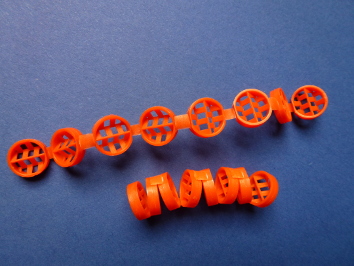
What is a food processor and how does it work?
A stationary mixer is a device consisting of a series of plates, paddles, or spiral structures housed within tubes or cylindrical chambers. As the liquid flows through these structures, it alternately separates, swirls, and recombines, creating a homogeneous mixture.
The main advantage of a stand mixer is that it has no moving parts , therefore it requires neither mechanical energy nor special maintenance, and the flow energy alone is sufficient for mixing.
Application areas include, but are not limited to, the following:
-
Mixing two or more liquids of different viscosities
-
A mixture of gas and liquid or liquid and powder
-
Adjust the pH level or add chemicals for water purification.
-
Mixture of polymers and resins in the production of plastics and composite materials
The Stamixco Static GXM mixing element is designed for mixing and distributing viscous liquids.
Problems in the manufacture of conventional stationary mixers
Traditionally, fixed faucets are manufactured using processes such as cutting, welding, bending, and casting
. While these methods are effective, they have some limitations:
-
Geometric complexity: It is difficult to produce structures with 3D paths or nonlinear propeller blades using conventional tools.
-
High costs: Every design change requires the creation of new templates or tools.
-
Long production time: Machining and assembling the many parts takes a lot of time.
-
Connections and leaks: Welded or manufactured connections can cause leaks or pressure losses.
-
Heavier: Traditional metals are heavier than modern printing materials.
All these problems have led manufacturers to find a new solution: 3D printing of stationary mixers.
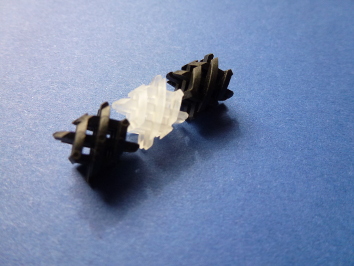
3D printing technology: A solution for free design
3D printing, also known as additive manufacturing, is a process that uses polymers, metals or composite materials to build components layer by layer.
This technology offers a number of crucial advantages in the manufacture of stationary mixers:
-
Complex internal structures can be designed to improve fluid flow .
-
Complete elimination of assembly and welding
-
Reduced weight and improved flow efficiency
-
Rapid prototyping for computational fluid dynamics testing.
-
Configurable for specific applications
Steps for making a stand mixer using a 3D printer
1. Digital Design (CAD)
First, the engineers design a 3D model of the mixer using design software such as SolidWorks, CATIA, or Fusion 360. The following criteria must be considered during this phase:
-
Inner diameter of the pipe
-
Number and angle of the leaves
-
Acceptable low blood pressure
-
It is necessary to consider the type of liquid and its viscosity.
2. Flow simulation (numerical fluid mechanics modeling)
Before printing, the model should be tested using CFD (Computational Fluid Dynamics) software such as ANSYS Fluent or COMSOL to analyze the mixture’s mass distribution, pressure drop, and velocity distribution.
The results of this analysis will contribute to improving the design.
3. Specify the printing technology and materials.
If necessary, you can use one of the following methods:
-
Fused Deposition Modeling (FDM): Suitable for polymers and laboratory samples.
-
Selective laser sintering (SLS): Used for printing on reinforced nylon or polyamide .
-
SLA (Stereotype Printing): Used for high-resolution printing with synthetic resins.
-
DMLS (Direct Metal Laser Sintering): Used for printing on metals such as stainless steel, titanium and aluminum.
4. 3D printing (additive manufacturing)
The developed model is converted into a G-code file and printed layer by layer.
During this phase, it is important to precisely adjust parameters such as nozzle temperature, printing speed, layer thickness, and printing direction to achieve a smooth surface and accurate dimensions.
5. Payment processing and tracking
After printing, you can perform the following operations:
-
Cleaning powder or pad
-
Polishing the inner surface
-
Heat treatment (metal printing)
-
The surface sealing (painting) process is carried out
to ensure the parts are fixed to the production line.
Materials used in 3D printing for stand mixers
1. Technical polymers:
-
Nylon (PA12): lightweight and abrasion-resistant , suitable for non-aggressive liquids.
-
PEEK: High temperature resistance up to 250 degrees Celsius
-
Polypropylene (PP): suitable for the food and chemical industries.
-
ABS: Suitable for prototypes and low-stress applications.
2. Minerals:
-
Stainless steel 316L: corrosion-resistant, suitable for the chemical and food industries.
-
Titanium: lightweight and durable, suitable for the pharmaceutical industry.
-
Inconel nickel alloys: High temperature resistant, suitable for the oil and gas industry.
3. Composite materials:
The combination of polymers with fiberglass or carbon fiber enables increased strength and durability.
The advantages of using 3D printers in the production of stationary mixers
| Advantages | He explains |
|---|---|
| Innovative and improved design | This method enables the construction of structures with ideal flow patterns, which is impossible with conventional methods. |
| weight loss | It is 50% lighter than conventional metal models while maintaining its mechanical strength. |
| High production speed | The entire mixer can be printed in hours instead of days. |
| Reducing prototyping costs | Requires neither watering nor further processing. |
| Structural security | The absence of joints and welds reduces the likelihood of leaks and contamination. |
| Fully customizable features | Depending on the type of liquid or the flow conditions, any design can be printed. |
Industrial application
-
Oil and gas industry: Addition of additives to pipelines or injection of chemicals
-
Chemical industry: Mixing reagents in continuous production lines
-
Wastewater treatment plants: Addition of chlorine or flocculants.
-
Food industry: Mixture of viscous substances, sauces or emulsions.
-
Pharmaceutical products: a precise mixture of active ingredients and solvents
-
Polymers and resins: a homogeneous mixture of pigments or additives
In many industries, 3D printing technology has enabled the production of small, compact fittings that can be installed without the need to set up a production line.
Practical example: Use of DMLS technology for the production of stationary mixers.
As part of an industrial project, a European company used direct metal laser sintering (DMLS) technology to manufacture a stationary mixer from 316L stainless steel powder . The result:
-
Compared to the mechanical model, the weight could be reduced by 40%.
-
The quality of the mixture has improved by up to 20%.
-
Optimal flow channel design minimizes pressure loss.
-
Manufacturing can be completed in less than 12 hours; no assembly is required.
This project proves that 3D printing can be used not only for prototyping but also for the final production of technological devices .
Economic analysis and comparison using traditional methods
| index | traditional methods | 3D printing |
|---|---|---|
| Production time | from 3 to 10 days | From 6 to 24 hours |
| Cost of the mold | Upper part (shape, workmanship) | strange |
| Precision engineering | Tools only | Very large |
| Design changes | New tools are needed. | Fast and digital |
| Durability in harsh environments | By gender | The materials range from metals to polymers. |
| High production capacity | suitable | Several printers in parallel are required. |
Although 3D printing can be more expensive than traditional mass production methods, it can be cost-effective in certain laboratories or for individual applications.
Limitations and problems
Every technology has its limitations. Furthermore, the production of stationary faucets using 3D printing technology presents a number of challenges:
-
Component size limitations (depending on printer size)
-
The FDM process exhibits low accuracy on the inner surface.
-
Polishing is necessary to prevent the accumulation of deposits and dirt.
-
Metal printing materials are expensive.
-
The production process requires a professional operator specializing in industrial design and printing.
However, the rapid development of industrial 3D printers (such as those from EOS, Renishaw and Markforged) eliminates these limitations.
The future of 3D-printed stand mixers
In the near future we expect:
-
Use of artificial intelligence to improve the design and efficiency of hybrid systems
-
By using multi-material printing technology, structures with different properties can be created in different parts of the mixer .
-
Improved resistance to heat and chemicals through the use of new materials such as printed ceramics.
-
Automated mass production using industrial printing robots
Large chemical and pharmaceutical companies have also begun to use print-on-demand systems to manufacture specialized equipment on site.
Quality standards and requirements
Although 3D printing technology is relatively new, international organizations are working on developing corresponding standards, including:
-
ASTM F42 – Standard for additive manufacturing
-
ISO/ASTM 52900 – Terminology of additive manufacturing
-
ASME BPVC Band 8 (for pressed metal parts)
Compliance with these standards is crucial for ensuring safety, surface quality and durability in the manufacture of industrial valves.
In conclusion
The use of 3D printing technology in the manufacturing of stationary mixers represents a significant advance in the digital transformation of the process industry. This technology enables engineers to realize previously impossible designs: lightweight, precise, easy-to-assemble, and highly efficient mixing components .
Given decreasing printing costs, increasing speeds, and the development of more robust materials, the future of process plant design, particularly in the areas of mixing and material handling, will undoubtedly depend on the following…