In large sizes, we usually use polyethylene static mixer PE for general applications. This material is less expensive than PVC, but in large sizes, this price difference will be significant.
Introduction
Static Mixers are vital tools in various industrial processes used to mix liquids, gases and solid particles. These mixers are used in many industries due to their simple and efficient design. Polyethylene (PE) material is one of the most widely used materials in the manufacture of static mixers due to its unique properties. In this article, we have examined the working principles, features and applications of static mixers with polyethylene material.
Working principles of static mixer
Definition of static mixer
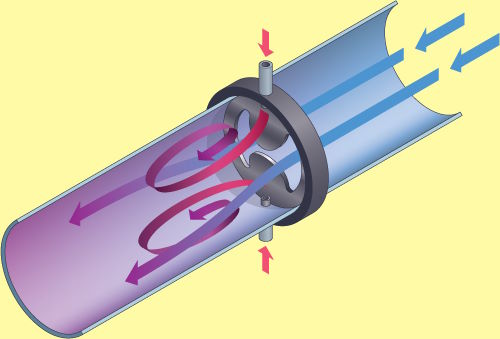
A static mixer is a mixing device that mixes materials without the need for moving parts. These devices consist of a set of fixed mixing elements located inside a tube or chamber. As the materials pass through these elements, they are mixed homogeneously due to changes in direction and multiple branches.
Static mixer performance
The operation of a static mixer is based on the principles of hydrodynamics and fluid flow. The mixing elements within the mixer are designed to divide the material flow into several smaller streams in a regular manner and then combine these streams. This process results in homogeneous mixing of the materials. Static mixers usually do not require external power and operate solely using the energy of the material flow.
Polyethylene (PE) material
What is polyethylene?
Polyethylene is a thermoplastic polymer that is used in many industrial applications due to its unique properties. Polyethylene is known as a plastic material with high resistance to chemicals, heat and impact. This material has superior mechanical and chemical properties that make it one of the main choices for the manufacture of static mixers.
Properties of polyethylene (PE)
- High chemical resistance : Polyethylene has high resistance to many chemicals and solvents, which helps improve the useful life of mixers.
- Heat resistance : Polyethylene has good heat resistance and the ability to function at different temperatures.
- Lightweight : Due to its lightweight, polyethylene helps reduce the overall weight of mixers, making them easier to transport and install.
- Mechanical strength : Polyethylene has good mechanical strength and impact resistance, which helps increase the durability and efficiency of mixers.
- Non-absorbent to moisture : Polyethylene has waterproof properties and does not absorb moisture, which helps improve the performance and useful life of mixers.
Static characteristics of mixer with polyethylene (PE) material
1. Corrosion resistance
One of the outstanding features of static mixers made of polyethylene material is their high resistance to corrosion. These mixers can withstand the chemical effects of various materials and prevent damage and deterioration caused by corrosion.
2. High accuracy
Static mixers with polyethylene material have high precision in mixing materials. These mixers can mix materials homogeneously and uniformly, which helps improve the efficiency and accuracy of processes.
3. Long lifespan
Due to the superior mechanical and chemical properties of polyethylene, static mixers made from this material have a long service life. This feature helps reduce the need for mixer repairs and replacements and reduces maintenance costs.
4. Stable performance
Static mixers with polyethylene material have stable and reliable performance. These mixers can perform well in harsh working conditions and different temperatures and provide a uniform flow of materials.
5. Compatibility with various chemicals
Polyethylene has high compatibility with various chemicals. This property allows static mixers to perform well in mixing a variety of chemicals, even corrosive and sensitive materials.
Static mixer applications with polyethylene (PE) material
1. Chemical industry
In the chemical industry, static mixers with polyethylene material are used to mix various chemicals including acids, bases and solvents. The high chemical resistance and mixing accuracy of these mixers help improve the efficiency and quality of chemical processes.
2. Petrochemical industries
In the petrochemical industry, static mixers with polyethylene material are used to mix chemicals and additives in production and refining processes. These mixers are widely used in this industry due to their high resistance to chemicals and ability to operate in harsh conditions.
3. Pharmaceutical industries
In the pharmaceutical industry, static mixers with polyethylene material are used to mix pharmaceuticals and sensitive solutions. The high precision and chemical compatibility of these mixers help improve the quality and safety of pharmaceutical products.
4. Food and beverage industry
In the food and beverage industry, static mixers with polyethylene material are used to mix additives and preservatives into production processes. These mixers are very useful in this industry due to their high resistance to chemicals and ability to operate at different temperatures.
5. Water and wastewater treatment
In water and wastewater treatment systems, static mixers with polyethylene material are used to mix chemicals such as chlorine, antiscalants, and antifouling agents. These mixers help improve water quality and reduce problems caused by fouling and corrosion.
Advantages of using a static mixer with polyethylene (PE) material
1. Improve efficiency and accuracy
The use of static mixers with polyethylene material helps to improve the efficiency and accuracy of material mixing processes. These mixers can mix materials homogeneously and uniformly , which leads to improved performance and reduced material waste.
2. Reducing maintenance and repair costs
Due to the high resistance and long static life of the polyethylene mixer, the need for repairs and replacement of mixers is reduced. This feature helps reduce maintenance and repair costs and increases economic efficiency.
3. Increased safety and reliability
Static mixers made of polyethylene material are safe and reliable due to their high corrosion resistance and chemical compatibility. This feature helps reduce the risks of chemical leakage and mixer failure, and provides stable and reliable performance.
4. Environmental compatibility
Polyethylene, as a durable and resistant plastic material, has a high environmental compatibility. Using a static mixer with polyethylene material helps reduce the consumption of harmful chemicals and reduce environmental pollution.
Polyethylene (PE)
Polyethylene materials are produced from raw materials derived from natural gas by two primary polymerization processes.
The low-pressure polymerization process results in linear polymer chains with short side branches. Density changes in the resulting polymer are accomplished by varying the amount of comonomer used with ethylene during the polymerization process.
The high-pressure polymerization process results in polymer chains with highly developed side branches. Density changes in the resulting polymer are accomplished by varying the temperature and pressure used during the polymerization process.
The physical properties of polyethylene materials are specific to each grade or type and can be modified by changes in density and molecular weight distribution. General physical properties are given in the table below.
A large number of grades of polyethylene materials are used in piping and fitting systems, with specific properties designed for specific applications. Vinidex can be consulted for guidance on the most effective selection for each installation. The most common types of polyethylene materials are as follows:
Low density polyethylene (LDPE)
LDPE has a highly branched chain structure with a mixture of small and large side chains. The density of LDPE is between 910-940 kg/m3 and LDPE exhibits high flexibility and property retention at low temperatures.
The main application of LDPE in piping is in micro-irrigation or drip pipes with sizes up to 32 mm in diameter.
LDPE materials may be modified with elastomers (modified rubber) to provide environmental stress crack resistance (ESCR) values in fine irrigation applications where the pipes operate in open environments and while carrying agricultural chemicals.
Linear low density PE (LLDPE)
LLDPE has a chain structure with little side branching and a narrower molecular weight distribution resulting in improved ESCR and tensile properties compared to LDPE materials. LLDPE materials may be used as a single polymer or as a blend with LDPE, in micro irrigation applications to take advantage of the material’s flexibility.
PE80 and PE100
The first polyethylene pipe material used in engineering applications was high-density polyethylene type 50 (HDPE) with a long-term tensile strength of 50 MPa. Subsequently, medium-density polyethylene (MDPE) materials, with improved pipe properties compared to the previous high-density materials, were used in pipes due to their flexibility, ductility, resistance to slow crack growth, and resistance to crack propagation.
The second and third generation polyethylene pipe materials currently in use may be medium or high density materials and are now referred to by their Minimum Required Strength (MRS). PE80 pipe materials have an MRS of 8.0 MPa and PE100 materials have an MRS of 10.0 MPa. Polyethylene pipes are widely used in pressure and non-pressure applications such as water supply, sewage, gas mains, small diameter pipe coils, mobile irrigation coils, power and communication pipes, and mining and industrial applications.
Material classification and stress regression
Hydrostatic design stress
The allowable hydrostatic design stress is based on the minimum required strength (MRS), which in turn is obtained from the stress regression curves.
Stress regression curves are generated from short-term and long-term compression tests of pipe specimens. Since there is a linear relationship between the logarithm of the applied stress and the logarithm of the time to failure, the test points are plotted and extrapolated to an arbitrarily selected 50-year point.
In some cases, especially at higher temperatures, there is an abrupt change in the slope of the regression curve, known as a “knee.” The knee, as shown in the figure below, represents the transition from a ductile to a brittle failure mode.
The relationship between the curves for different test temperatures allows the prediction of the knee position at 20°C based on the known position at the elevated temperature. This in turn allows the prediction of the ductile life at 20°C.
The predicted ring stress value (97.5% lower prediction limit) is determined at the 50-year point. Accordingly, the PE compound is classified as PE 80 or PE 100 according to the minimum required strength (MRS) of the material, i.e. 8.0 or 10.0 MPa.
The hydrostatic design stress is obtained by applying a factor, not less than 1.25, to the MRS value. It is emphasized that the stress regression curves form the basis of design only and do not predict the life of the system.
Stress regression curves
To design a pipe with the required thickness for a given pressure and diameter, for example, the following formula applies:
σ = MRS/C
σ = P(De)/2e
Performance aspects of polyethylene materials
Abrasion resistance
The transport of solids in liquid or gas carriers in polyethylene pipelines results in wear of the inner walls of the pipe, especially at high-flux points such as bends or joints. The high abrasion resistance, flexibility, light weight and strength of Vinidex polyethylene pipes have led to their widespread use in applications such as the transport of slurries and mine tailings. Wear occurs as a result of friction between the pipe wall and the particles being transported. The actual amount and rate of wear of the pipe wall is determined by a combination of the following:
- Specific gravity of solids
- Solid content in slurry
- Shape, hardness and size of solid particles
- Fluid velocity
- Polyethylene pipe material grade
The interaction of these parameters means that any prediction of wear rate can only be made if wear rate testing has been carried out on the specific slurry under the proposed operating conditions. Under different test conditions, the relative ratings of different pipe materials may change, and testing should be carried out where possible.
In general, polyethylene pipes have a higher abrasion resistance than steel, ductile iron, FRP, asbestos and fibre reinforced cement pipes, providing a more cost-effective solution for the installation of abrasive slurry. Laboratory test programmes have been carried out in the UK, Germany and the USA to obtain relative abrasion comparisons for different materials using sliding and rotating pipe surfaces. The results of test programmes using the Darmstadt (Germany) Kirchmer method and reported by Meldt (Hoechst AG) for a quartz sand water slurry with a solids content of 46% by volume and a flow velocity of 0.36 m/s are shown in Figure 2.2.
These were carried out on a wide range of materials and demonstrate the excellent abrasion resistance of polyethylene pipe materials. Similarly, Boothroyde and Jacobs (BHRA PR 1448)1 conducted closed loop tests using iron ore slurry in the 5 to 10% concentration range and found PE to be superior to mild steel and asbestos cement in terms of abrasion resistance. For most grades, the difference in abrasion resistance between MDPE and HDPE is not significant.
The design of joints involving changes in flow direction in slurry lines is very important. The slower the change in direction, the less wear. A large centerline radius should be used for bends. If possible, a radius of at least 20 times the pipe diameter should be used, along with a long, straight, seamless length.
In practice, the effective life of a polyethylene pipeline can be extended by using detachable joints to periodically rotate the polyethylene pipe sections to distribute wear evenly around the pipe circumference.
Weathering
Weathering of plastics occurs by the process of surface degradation or oxidation due to the combined effect of ultraviolet radiation, increased temperature, and humidity when pipes are stored in exposed locations.
All Vinidex polyethylene pipe systems contain antioxidants, stabilizers and pigments to protect in Australian construction conditions. Black polyethylene pipes contain carbon black which acts as both a pigment and a UV stabilizer and these pipes do not require additional protection for storage and external use.
Other colours such as white, blue, yellow or purple do not have the same stability as black pigment systems and for optimum retention of properties the exposure period should be limited to two years. With these colour systems, external surface oxidation layers develop more rapidly than with PE pipes stabilised with carbon black. For exposure periods exceeding two years, additional protection such as coating should be adopted.
Where non-black pipe is required for longer periods of exposed service, contact Vinidex for advice. For more information on weathering of polyethylene pipe, refer to Technical Note VX-TN-6C, Weathering of Polyethylene Pipe.
Influence
Infiltration of polyethylene pipe systems from external sources may occur when the surrounding soils are heavily contaminated. Infiltration is complex and depends on factors such as soil type, contaminant concentration, temperature, diffusion, pipe diameter and wall thickness, and flow velocity in the pipe. Non-polar, low molecular weight organic compounds are those that penetrate the walls of polyethylene pipes most rapidly. Accordingly, where substances such as aliphatic hydrocarbons, chlorinated hydrocarbons, and alkylated benzenes are encountered in sufficiently high concentrations, consideration should be given to an impermeable conduit. Soil sampling should be performed if contamination is suspected, and in the case of drinking water transmission lines, protection of polyethylene pipes should be provided where contamination is found in significant concentrations.
Biological resistance
Polyethylene pipes may be subject to damage from biological sources such as ants or rodents. Resistance to attack is determined by the hardness of the polyethylene used, the geometry of the polyethylene surfaces and the installation conditions. Small diameter irrigation applications using LDPE materials may be subject to attack by ants or termites due to the relatively thin wall sections and the hardness of LDPE. In these cases the ant source should be treated with conventional insecticide techniques. Both MDPE and HDPE materials have a higher hardness value than LDPE and, together with the thicker pipe wall sections used in PE63, PE80 and PE100 applications, provide a generally resistant solution. In small diameter pipes, the thin wall sections may be damaged by termites in severe cases. However, PE is not a food source and the damage often attributed to termite attack in PE is subsequently due to other sources of mechanical damage. Polyethylene pipe systems are generally not affected by biological organisms in land and marine applications, and the paraffinic nature of polyethylene pipe surfaces delays the growth of marine growth in service.
Electrical conductivity
Vinidex polyethylene pipes are non-conductive and cannot be used for electrical grounding or static discharge purposes.
Where polyethylene pipes are used to replace existing metal water pipes, the designer should consider existing systems used for earthing or corrosion control purposes. In these cases, the appropriate electrical supply authority should be consulted to determine their requirements.
Static electricity
Static electricity may build up on the surface of polyethylene pipe as a result of friction during handling, gas flow, compression, and purging.
In dry, dusty or explosive atmospheres, the generation of electrical potential must be assessed and safe static dissipation measures taken to prevent any possibility of explosion.
Fire rating
Polyethylene pipe systems support combustion and are therefore not suitable for use in fire rated areas in buildings where there is no adequate protection. Individual fire rating indices for polyethylene materials may be determined by testing in accordance with the requirements of AS1530.
In multi-storey buildings, polyethylene systems penetrating floor voids shall be enclosed in fire rated service ducts appropriate to the relevant building class or devices such as fire dampers shall be installed in accordance with the manufacturer’s instructions.