The polymer industry, a key sector for raw material extraction in various industries, constantly requires advanced methods and equipment to optimize its production processes. One of the central challenges in polymer production is temperature control of the materials during the different production phases. Cooling polymers after thermal processes such as polymerization or extrusion is crucial, as inadequate temperature control can reduce the quality of the final product, alter its physical and chemical properties, and even damage equipment. A stationary mixer is an effective tool in the polymer cooling process.
What is a food processor?
A stationary mixer is a device installed in pipes or conduits. It mixes and combines fluid streams without any moving parts. The device consists of stationary, specially designed components that continuously separate, rotate, and merge the fluid streams. This process improves heat exchange, optimizes material mixing, and reduces temperature gradients within the fluid.
The importance of cryogenic polymers
Polymers are exposed to high temperatures during manufacturing processes such as polymerization, extrusion, and injection molding . After these processes, they must be cooled quickly and uniformly to stabilize their molecular structure and retain the desired properties. Insufficient cooling can lead to internal stresses, deformation, reduced mechanical strength, and even polymer degradation. Therefore, the use of effective cooling methods for polymers is crucial.
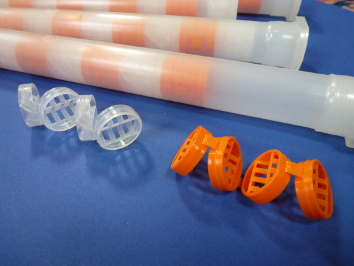
The role of a stationary mixer in the cooling of polymers
Stationary mixers offer numerous advantages as an effective tool for cooling polymers. They contribute to lowering the polymer temperature by improving heat exchange and ensuring a uniform flow. Below are some examples of the applications and benefits of stationary mixers in this process:
1. Improved heat transfer
A static mixer creates turbulence in the polymer flow , thereby increasing the contact area between the polymer and the cooling fluid (e.g., water or air). This significantly improves heat exchange and reduces cooling time. As a result, the polymers cool down quickly and evenly.
2. Uniform cooling
A common problem in polymer cooling is uneven temperature distribution. A static mixer prevents hotspots by continuously dividing and mixing the polymer stream and ensures uniform cooling of all polymer components.
3. Reduce processing time
Using a stationary mixer significantly reduces the polymer’s cooling time . This not only increases production speed but also lowers energy costs.
4. Reduction of operating costs
Stand mixers reduce maintenance and repair costs thanks to their simple design and the absence of moving parts. Furthermore, improved cooling performance lowers energy consumption and associated costs.
5. Application possibilities in different systems.
Stand mixers can be used with various cooling systems, such as water, air, or oil cooling. This versatility makes them an indispensable tool in the polymer industry.
6. Prevention of polymer degradation
Insufficient cooling can lead to polymer degradation in some cases. Precise temperature control and the avoidance of hotspots in a static mixer prevent polymer degradation and improve the quality of the final product.

How does a stationary polymer cooling mixer work?
A static mixer is installed in the polymer transport lines. As the hot polymer flows through the line, the elements of the static mixer continuously separate and collect the polymer flow. This creates flow turbulence, increasing the contact area between the polymer and the cooling fluid. The result is efficient heat exchange and rapid cooling of the polymer.
General advantages of using a stand mixer
- Improving the efficiency of the cooling process
- Reduction of production lead times and costs
- Improvement of the quality of the final product
- Reduction of energy consumption
- Easy installation and maintenance
- Can be used in various cooling systems.
Diploma
A static mixer, an effective tool, plays a crucial role in the polymer cooling process . This device increases production efficiency and reduces costs through improved heat transfer, uniform cooling, and shortened curing time. In the polymer industry, the use of a static mixer not only improves the quality of the final product but also prevents polymer degradation. Due to its numerous advantages, it is considered an ideal solution for polymer cooling processes.
Selecting and designing the right stationary mixer for a specific application requires considering numerous factors such as polymer type, temperature, pressure, and flow rate. However, when used correctly, this equipment can achieve the desired results and significantly improve polymer production processes.